Key Takeaways
Standardize Operations: Multi-cluster architecture requires shifting from manual coordination to centralized, consistent governance across all clouds and on-prem environments.
Prioritize Automation: Reliability at scale hinges on implementing GitOps and Policy-as-Code (PaC) as non-negotiable architectural mandates.
Boost SRE Efficiency: Fragmentation increases MTTR. Future-proofing requires unified observability and adopting AI/AIOps for proactive failure detection.
Consolidate Tools: The platform approach is superior to tool-stitching, simplifying the full application lifecycle (CI/CD, governance, security, and operations).
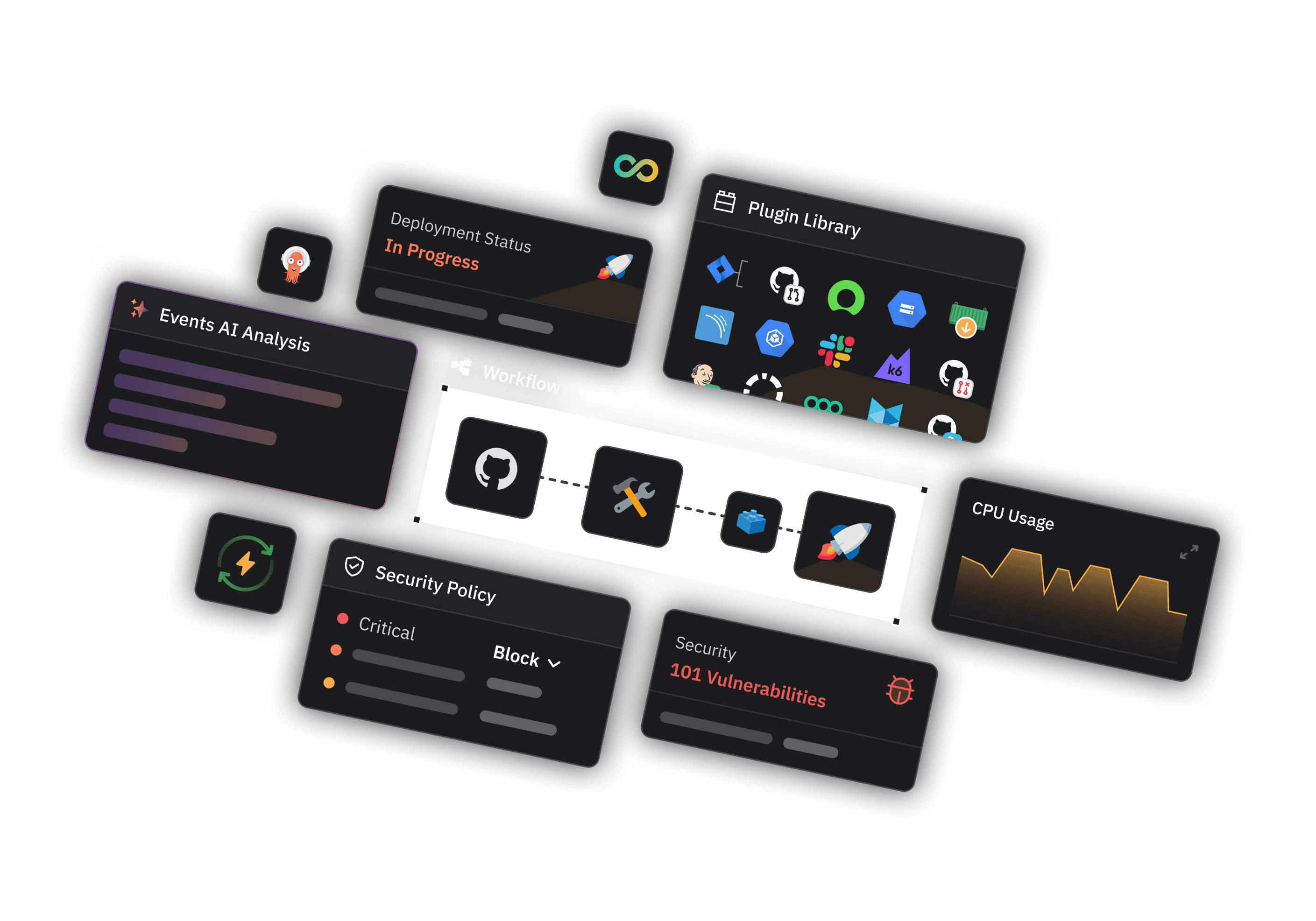
The Devtron Advantage: Devtron unifies all these elements into one AI-native, GitOps-driven control plane designed specifically to help Platform Engineering teams manage complex, multi-cluster fleets end-to-end.
Summary Box
Key Trends & Takeaways | Details |
Operational Default | Multi-cluster Kubernetes is now the standard operating model for modern, distributed, and regulated environments. |
Primary Challenge | Governance, configuration consistency, and observability become exponentially harder as clusters scale (The Tool Sprawl Problem). |
Mandatory Practices | Centralized GitOps, policy-as-code (PaC), unified observability, and immutable workflows are essential to maintain reliability. |
Emerging Differentiator | AI-native operations (AIOps) are a must-have for proactive troubleshooting and scalable SRE efficiency. |
Platform Focus | Devtron provides an AI-native, GitOps-driven, full-lifecycle platform purpose-built to unify and simplify multi-cluster Kubernetes management. |
Introduction
By 2026, multi-cluster Kubernetes has become the operational baseline for organizations running globally distributed applications, navigating regulatory boundaries, or adopting hybrid and multi-cloud architectures. Clusters now span AWS, GCP, Azure, private data centers, and emerging edge environments — creating new layers of operational complexity.
While this distribution improves resilience and reduces blast radius, it also introduces a new challenge for platform teams:
How do you maintain consistent governance, security, and developer velocity across an expanding fleet of clusters?
This guide explores:
The core challenges of managing multi-cluster Kubernetes environments
The architectural best practices required for consistency and scale
A comparison of the top Kubernetes management platforms for 2025–2026
How Devtron, an AI-native, unified platform, simplifies and accelerates multi-cluster operations at scale
How Devtron Simplifies Multi-Cluster Kubernetes Management
Devtron is engineered specifically for Platform Engineering teams seeking a unified approach to application delivery, cluster governance, and fleet-wide reliability. Instead of stitching together CI/CD, GitOps, observability, policy enforcement, and cost tools, Devtron delivers them in one coherent platform.
Key Capabilities:
Integrated GitOps + CI/CD: Devtron unifies Argo CD/Flux-based GitOps with built-in CI/CD pipelines to enforce consistent, immutable configuration across all clusters, dramatically reducing drift and manual intervention.
Unified Full-Lifecycle Control: From build to deploy to observe, Devtron centralizes policy enforcement, cost insights, deployment governance, and fine-grained Enterprise RBAC into a single experience - reducing tool sprawl and operational overhead.
AI-Native Operational Intelligence (Agentic SRE): Devtron’s Agentic SRE analyzes events across distributed clusters, correlates signals, and assists teams with guided troubleshooting and early detection of anomalies, automating up to 70% of routine incidents.
Hybrid and Multi-Cloud Coverage: Whether a team operates clusters on AWS, GCP, Azure, or on-prem infrastructure, Devtron maintains uniform governance and delivery workflows across the entire fleet.
Try Devtron now - Explore a unified, AI-native Kubernetes management platform
Key Challenges in Multi-Cluster Kubernetes Management
Managing multiple clusters introduces structural challenges that cannot be resolved through manual processes or isolated tools.
Environmental Divergence: Different provisioning methods, cloud providers, and network patterns create hidden configuration inconsistencies that amplify debugging complexity.
Configuration Drift: Manual changes at the cluster level cause environments to deviate from the intended Git-defined state, eroding reliability and compliance.
Security & Compliance Complexity: Distributed clusters typically mean fragmented RBAC models, inconsistent scanning, and decentralized policy enforcement.
Fragmented Observability: Logs, metrics, and traces spread across disparate dashboards force engineers to manually correlate failures, severely increasing Mean Time To Resolution (MTTR).
Operational Inefficiency & Cost Sprawl: Without standardized workflows, teams overspend on compute, underutilize resources, and struggle to maintain predictable operating models (FinOps).
These challenges highlight the need for a unified platform engineered for consistency, automation, and policy enforcement at scale.
Best Practices for Multi-Cluster Kubernetes Management
Platform teams succeeding at scale follow a set of non-negotiable practices:
Adopt GitOps for All Configuration Management: Use Git as the centralized source of truth for cluster and application configuration to ensure versioning, auditability, and consistency.
Centralize Policy-as-Code Governance: Enforce RBAC, security standards, and compliance policies uniformly across clusters using PaC frameworks.
Build Unified Observability Across the Fleet: Aggregate logs, metrics, events, and traces (ideally via OpenTelemetry) to accelerate fault isolation and improve root cause analysis.
Automate Cluster Lifecycle Operations: Standardize cluster provisioning, upgrades, and retirement workflows to reduce manual overhead and risk.
Prioritize Resource Efficiency (FinOps): Use intelligent autoscaling and standardized resource management to optimize cloud consumption.
Devtron supports all these practices natively, enabling consistency across all environments.
Criteria to Evaluate Kubernetes Management Platforms
When choosing a platform for multi-cluster operations, teams should prioritize tools that excel in:
Criteria | Description |
Hybrid/Multi-Cloud Breadth | Treat cloud, on-prem, and edge clusters as first-class citizens under a unified control plane. |
Governance & Policy Automation | Enforce RBAC, security scanning, and policies centrally. |
GitOps Integration | Maintain cluster and app consistency through deep Argo CD/Flux integration. |
Integrated Toolchain | Reduce tool fragmentation by consolidating CI/CD, policies, observability, and cost controls. |
Intelligence & Automation | Use AI for proactive insights and guided remediation (AIOps). |
Platforms that unify these capabilities deliver the strongest long-term operational value.
Comparison of Leading Kubernetes Management Platforms (2025–2026)
Platform | Multi-Cloud | AI-Native | Core Strengths | Ideal Use Case | Scope |
Rancher | Yes | Limited | Mature cluster governance and fleet control for experienced ops teams. | Large enterprises with existing CI/CD. | Infra-centric; relies on external toolchains for full lifecycle. |
Portainer | Partial | Minimal | Simplified UI and lightweight orchestration for fast adoption. | Small teams or first-time K8s adopters. | Lightweight management; limited enterprise scale/governance features. |
Platform9 | Yes | Moderate | True SaaS-managed Kubernetes with minimal operational burden. | Ops-light teams seeking managed service experience. | Infra-managed; limited developer workflow features. |
Mirantis | Yes | Minimal | Enterprise-grade security, orchestration, and professional services. | Regulated industries requiring deep security assurance. | Strong infra + services; external CI/CD required. |
CAST AI | Yes | Strong | AI-driven cost optimization and autoscaling. | Cost-focused teams, especially large cloud spenders. | Optimization-only; not a full CI/CD or governance platform. |
Devtron | Yes | Strong | AI-native Kubernetes Management Platform, GitOps-first platform with integrated CI/CD, policies, cost, and observability. | Built for both enterprises and small teams adopting Kubernetes or managing large-scale Kubernetes environments. | End-to-end lifecycle: build, deploy, secure, observe, govern. |
Devtron stands out as the only platform that combines multi-cluster governance, GitOps automation, full CI/CD, observability, and AI-assisted operations into one unified system.
Mapping Use Cases to Platform Types
Small teams / basic container management: Portainer
Hybrid-cloud governance for power users: Rancher, Platform9
Compliance-heavy and regulated sectors: Mirantis, Devtron
Cost-first optimization: CAST AI
Unified CI/CD + GitOps + policies + AI for multi-cluster fleets: Devtron
Future Trends in Kubernetes Management (2026 and Beyond)
Autonomous Operations: AI (AIOps) will evolve from assistance to automated remediation and predictive reliability, significantly reducing the human operational workload.
Mandatory Policy-as-Code: Regulated and enterprise environments will require PaC to be uniformly enforced as a governance and security baseline.
Developer-SRE Workflow Convergence: Platforms must provide consistent, self-service workflows that unify delivery, security, and operations.
Edge-Driven Multi-Cluster Expansion: Lightweight, consistent governance for edge clusters will become essential as IoT and local processing grow.
Platforms capable of unifying application delivery and multi-cluster governance will lead this transition.
How to Choose the Right Platform
When evaluating platforms:
Assess whether the tool can scale governance from 10 to 1,000+ clusters.
Map security, compliance, and RBAC needs platform capabilities.
Prioritize consolidation of CI/CD, GitOps, visibility, and costs.
Ensure alignment with long-term AI and automation goals.
Run pilots focused on cross-cluster deployments and policy enforcement.
Devtron is designed for organizations seeking an integrated, future-ready platform that consolidates Kubernetes delivery and multi-cluster operations into a single, AI-native control plane.
Conclusion
As organizations adopt multi-cloud, hybrid, and edge architectures, multi-cluster Kubernetes management has become a foundational operational requirement. Success in 2026 depends on consistent governance, GitOps-driven workflows, centralized observability, and the intelligent automation of SRE functions.
Devtron’s AI-native architecture, integrated CI/CD, comprehensive GitOps automation, and centralized policy controls make it one of the most complete platforms for organizations scaling Kubernetes across complex, multi-cluster environments.
Frequently Asked Questions
What are the biggest challenges in Kubernetes management?
Complexity, multi-cluster visibility gaps, security misconfigurations, cost overruns, and operational overhead.
How much does Kubernetes downtime cost organizations?
Large enterprises can lose over $1 million per hour during major outages.
What percentage of organizations use Kubernetes in 2026?
More than 90% of containerized organizations use or actively evaluate Kubernetes.
How do Kubernetes management platforms reduce costs?
They provide cost visibility, enable right-sizing, and align engineering decisions with FinOps practices.
What’s the difference between Rancher, OpenShift, and Devtron?
Rancher focuses on cluster management, OpenShift is an enterprise Kubernetes distribution, and Devtron provides an end-to-end platform for CI/CD, security, observability, and cost management on Kubernetes.

Lead Quality Engineering
Results-driven Lead Quality Engineering professional with deep end-to-end ownership of the testing lifecycle, spanning integration, UI, API, performance, and security testing. Proven expertise in defining QA strategy, mentoring teams, and delivering scalable automation and AI-powered quality solutions that shorten release cycles, reduce risk, and elevate product reliability. Strong background in both hands-on engineering and cross-functional leadership to embed quality across the SDLC.
Categories