A use-case-driven technical comparison of Devtron and Harness for Kubernetes-first organizations. Explore differences in architecture, GitOps fleet management, Day-2 operations, AI-assisted debugging, and total cost of ownership.
A Use-Case Driven Technical Comparison: Devtron vs. Harness
For Technology Leaders Evaluating Kubernetes-Native Delivery Platforms | 2026
Architecture
K8s-native vs. Multi-runtime
Differentiators
Day-2 Ops · AI Debug · Fleet Mgmt
Deployment
Rolling · Blue-Green · Canary
Audience
Kubernetes-first Organizations
BEFORE YOU READ
Two Things to Know
Architecture is the differentiator. Devtron is Kubernetes-native by design. Harness is a multi-runtime platform adapted for Kubernetes. That structural difference drives most of the capability gap in this document.
Both platforms handle core deployments. Rolling, Blue-Green, and Canary strategies work on both. This comparison is about what happens beyond the deployment — fleet management, Day-2 ops, and the full delivery lifecycle.
AUDIENCE
Who This Comparison Is For
Platform Engineers designing or consolidating an internal developer platform
DevOps Leaders evaluating delivery tooling for Kubernetes-first environments
Cloud Architects comparing platform models at fleet scale
CTOs and Engineering Directors at Kubernetes-first organizations
Executive Summary
As Kubernetes becomes the dominant runtime for modern application delivery, platform teams face a structural decision: adopt a Kubernetes-native control plane purpose-built for this environment, or adapt a general-purpose multi-runtime platform that treats Kubernetes as one of many targets.
This document presents a use-case-driven technical comparison of Devtron and Harness, specifically for organizations where Kubernetes is the primary or exclusive runtime. Coverage spans cluster onboarding, Day-2 operations, AI-assisted debugging, GitOps fleet management, security, and total cost of ownership. It supports an informed platform evaluation — not the dismissal of either product.
Architectural Model Comparison
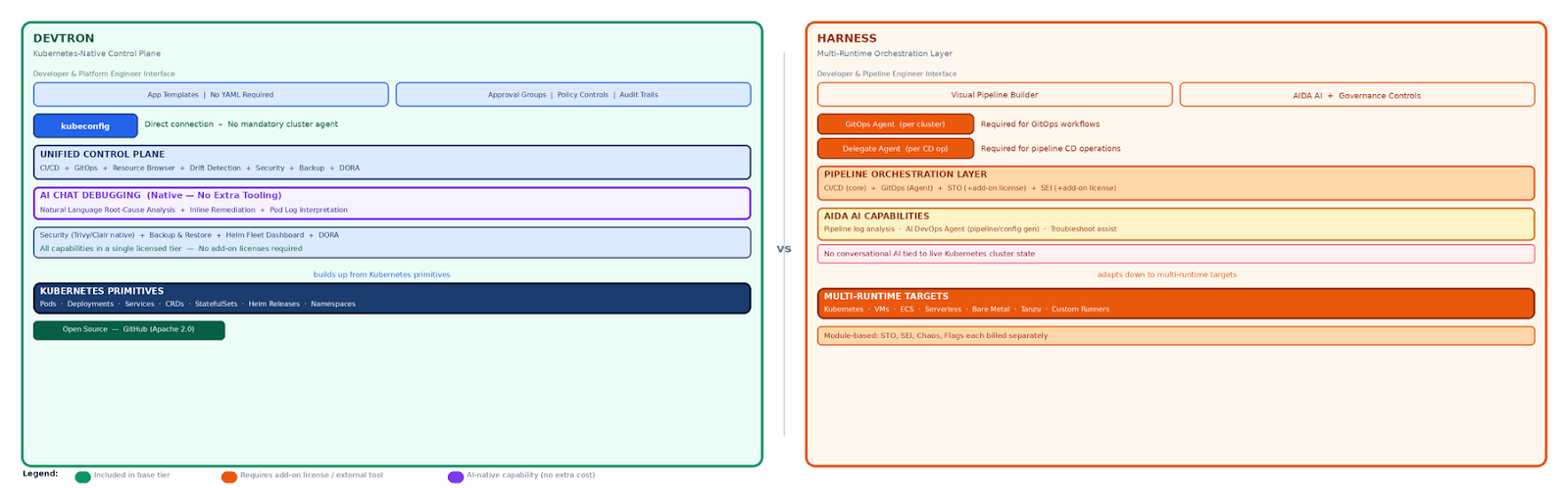
The core distinction is not features — it is architectural orientation. Devtron is built around Kubernetes primitives as the primary abstraction layer, with AI chat debugging embedded directly in the control plane. Harness is built around pipeline orchestration as the primary abstraction layer, with Kubernetes as one supported runtime among many.
Devtron vs Harness Comparison - At a Glance
Capability
Devtron
Harness
Platform Design
Kubernetes-native control plane
Multi-runtime enterprise (VMs, bare metal, multiple cloud platforms)
Cluster Onboarding
kubeconfig-based; no mandatory agent
GitOps Agent per cluster for GitOps;Delegate required for pipeline CD ops
Cluster-Side Agent
No mandatory agent for core CD
GitOps Agent for GitOps; Delegate for pipeline operations
For organizations scaling to 10, 50, or 100+ clusters, the per-cluster onboarding model has a direct and compounding impact on delivery velocity. The architectural difference between agent-based and kubeconfig-based connectivity is most visible at this scale.
Scenario: Your platform team needs to onboard 20 clusters across dev, staging, and production — spread across AWS, GCP, and on-prem.
Devtron
Clusters connect via kubeconfig. No mandatory cluster-side agent is required for core CD deployment workflows. This reduces the provisioning surface and simplifies onboarding, particularly in environments with strict network policies or constrained cluster-side compute budgets.
Harness
For GitOps-based deployments, a GitOps Agent must be installed per cluster. For pipeline-based CD operations (artifact triggers, PR pipeline steps), a Harness Delegate is additionally required. A single Delegate can serve multiple clusters, but each still requires its own GitOps Agent for GitOps workflows. At 20 clusters, provisioning, upgrading, and monitoring these per-cluster components creates compounding coordination overhead.
Platform Impact
Devtron reduces reliance on per-cluster runtime components. As cluster count grows, this translates into lower upgrade surface area and reduced cross-team coordination for platform changes.
USE CASE 2 — AI-NATIVE
Day-2 Operations & AI-Assisted Debugging
The real test of a Kubernetes delivery platform is not the deployment itself — it is what happens after. Incident response, drift investigation, and pod-level debugging are where platform architecture translates directly into engineer time. AI-assisted root-cause analysis is now a key differentiator.
Scenario: A deployment went out and pods are crashing across one of your 15 clusters. Your on-call engineer needs to identify the root cause, check live resource state, and roll back — without switching between multiple tools.
Devtron
Devtron's built-in Kubernetes Resource Browser provides live visibility into Pods, Deployments, StatefulSets, Services, ConfigMaps, Secrets, and CRDs. Engineers can view pod logs, compare manifest diffs, detect configuration drift, and execute version-based rollback — all from the same interface that triggered the deployment.
Devtron's integrated AI chat lets engineers describe a failure in plain language and receive context-aware root-cause analysis and step-by-step remediation — instantly, inside the platform. No terminal switching, no copy-pasting logs into a separate AI tool.
Harness
Harness provides AIDA for pipeline log analysis and anomaly detection during deployment (Continuous Verification). The AIDA AI DevOps Agent can generate pipeline YAML, create services, and troubleshoot pipeline failures from natural language — a genuine strength for pipeline authoring and setup.
Post-deployment cluster-level troubleshooting — inspecting live pod state, CRDs, or manifest diffs — is handled outside Harness via kubectl, Lens, or k9s. As of early 2026 documentation, Harness does not describe a conversational AI layer directly tied to live Kubernetes cluster state within the platform.
Platform Impact
When deployment visibility, live cluster inspection, and AI root-cause analysis all reside in one platform, on-call engineers resolve incidents faster — with no context-switching overhead. For high-frequency, multi-cluster teams, this consolidation translates directly into lower MTTR and fewer escalations.
USE CASE 3 - DevSecOps
Integrated DevSecOps for Kubernetes
Security scanning across the delivery lifecycle — from source through running workloads — is increasingly a compliance requirement, not an option. The key architectural question: are security controls embedded in the delivery platform, or maintained as a separately licensed module?
Scenario: Your security team requires vulnerability scanning at build time, image scanning before promotion, Kubernetes manifest policy enforcement before deploy, and runtime vulnerability visibility with audit trails for compliance.
Devtron
Devtron integrates vulnerability scanning (Trivy and Clair) natively into CI/CD workflows, supports Kubernetes manifest scanning and policy enforcement, and provides audit trails — all within the core platform. Security gates can block promotions based on policy.
Harness
Harness provides Security Testing Orchestration (STO), a capable module with broad third-party scanner integration — a genuine advantage for teams requiring coverage across many scanner types. STO is a separately licensed add-on with its own pricing, budgeted and activated independently from core CI/CD.
Platform Impact
Embedding security scanning in the core delivery platform ensures governance consistency — policies applied uniformly across teams, environments, and budget cycles without separate procurement or activation steps.
USE CASE 4 - Helm Application Management
Helm Application Lifecycle at Fleet Scale
Helm remains the most widely used packaging mechanism for Kubernetes workloads. Managing release versions, tracking drift, and coordinating upgrades across a fleet introduces a visibility gap that grows with cluster count.
Scenario: Your team runs 12 Helm-deployed applications across 8 clusters. You need visibility into which version of each release is running where, selective upgrade capability, and a path to bring existing Helm apps into CI/CD pipelines.
Devtron
Devtron provides a cross-cluster Helm lifecycle dashboard showing which versions are deployed where. The Helm Marketplace supports fast onboarding of third-party charts. Existing Helm applications can be migrated into Devtron-managed CI/CD pipelines in a single click — preserving Helm configurations while unlocking deployment windows, approval workflows, and security scanning.
Harness
Helm management in Harness is handled within individual deployment pipelines. A unified cross-cluster view of all Helm releases and their versions is not available natively. Migrating existing Helm workloads requires constructing pipelines manually per application.
Platform Impact
When teams must query clusters individually to see which chart versions are deployed, visibility degrades with scale. A dedicated Helm fleet view makes the release state continuously visible without additional scripting or tooling.
USE CASE 5 - Data Protection
Backup, Disaster Recovery & Data Protection
As stateful workloads move to Kubernetes, backup and restore become delivery-adjacent concerns. Whether these capabilities belong in the delivery platform or require separate procurement is an architectural question with compounding operational effects.
Scenario: Your organization runs stateful applications on Kubernetes and needs backup and restore capabilities managed within the same delivery platform — without purchasing a separate solution.
Devtron
Devtron includes native Kubernetes backup capability. Backup and restore workflows are managed within the same control plane as deployment — providing a consolidated operational interface and a unified audit trail for both delivery and data protection.
Harness
Harness does not include backup and restore in its core delivery modules. Organizations must integrate and operate external solutions such as Velero independently — introducing a separate operational workflow and additional procurement and integration overhead.
Platform Impact
Each additional tool a platform team must procure, integrate, and maintain represents engineering capacity that cannot be applied to platform improvement or product delivery.
USE CASE 6 - Developer Self Service Capabilities
Developer Self-Service & Kubernetes Abstraction
The measure of an internal developer platform is how quickly non-Kubernetes-expert developers can ship production workloads — while platform engineers retain governance control. This requires the right balance of abstraction and auditability.
Scenario: Your organization has 200 application developers and 8 platform engineers. You need a low-friction deployment experience while maintaining approval workflows, security gates, and audit trails.
Devtron
Devtron is designed as a no-code/low-code CI/CD workflow for Kubernetes. Application Templates let platform engineers define pre-approved configurations that developers use without writing YAML. Approval Groups enforce controlled promotion across environments. The integrated AI chat further reduces friction — developers can describe deployment failures in plain language and get immediate guidance.
Harness
Harness provides a visual pipeline builder and template-based pipeline construction, with the AIDA AI DevOps Agent enabling natural-language pipeline creation and troubleshooting. The interaction model is built around pipeline orchestration rather than Kubernetes-native abstractions. For developers primarily working with Kubernetes constructs, the abstraction mismatch can lengthen onboarding.
Platform Impact
Developer time-to-first-deployment is a concrete measure of abstraction quality. Kubernetes-native abstractions — combined with AI-assisted debugging — reduce both the initial onboarding gap and ongoing operational friction.
When Harness May Be the Right Choice
Harness is a capable enterprise platform with genuine strengths. It is likely the stronger choice in these scenarios:
Diverse runtimes. Your organization manages VMs, legacy infrastructure, ECS, bare metal, and multiple cloud-native platforms and needs a unified delivery layer across all of them. Harness's multi-runtime design is a deliberate advantage here.
For organizations where Kubernetes is the dominant or exclusive runtime, the modular licensing model and pipeline-centric abstraction are more likely to surface as friction than as a benefit.
Evaluation Checklist
The more 'Yes' rows that apply to your environment, the stronger the case for a Kubernetes-native control plane like Devtron.
Fits?
Your Environment & Runtime Strategy
Yes
Kubernetes is your primary or exclusive application runtime
Yes
You manage multiple clusters (dev, staging, production, or multi-cloud)
Yes
Your platform team is responsible for cluster lifecycle, not just pipelines
Yes
You are standardizing on GitOps (Argo CD, Flux CD, or both)
Yes
You need a self-hosted or open-source-compatible deployment option
No
You manage diverse runtimes (VMs, bare metal, multiple cloud platforms)
Fits?
Your Operational Requirements
Yes
You need live Kubernetes resource visibility inside the delivery platform
Yes
Your team loses time switching between deployment and debugging tools
Yes
You want AI chat root-cause analysis tied to live Kubernetes cluster state
Yes
You want drift detection across all environments, not only GitOps workflows
Yes
You manage Helm releases across multiple clusters and need fleet visibility
Yes
You need backup and restore without procuring a separate solution
No
Your primary debugging surface is pipeline logs, not live cluster state
Fits?
Your Security & Governance Requirements
Yes
You want security scanning included in the base platform — no extra license
Yes
You need policy enforcement as a deployment gate, not a separate audit step
Yes
You need a unified audit trail for deployment and security events
Yes
You require DORA metrics without a separate analytics module purchase
Fits?
Your Team & Developer Experience Goals
Yes
You want developers to deploy without writing Kubernetes YAML
Yes
You need template-driven deployment guardrails managed by platform engineers
Yes
Your developer onboarding speed is a platform success metric
Yes
You want AI-assisted debugging available without additional tooling or cost
CONCLUSION
Both Devtron and Harness are capable platforms. The evaluation criterion that matters most is architectural alignment.
For organizations where Kubernetes is the dominant runtime, a Kubernetes-native control plane like Devtron offers tighter integration across the delivery lifecycle, a lower per-cluster footprint, and a more complete out-of-the-box platform — without requiring multiple module purchases to reach production-grade delivery. Devtron's integrated AI chat debugging is designed to reduce MTTR by giving engineers instant, context-aware root-cause analysis and remediation guidance directly within the platform — no external AI tool required.
For organizations managing diverse runtimes or requiring modular enterprise tooling across heterogeneous infrastructure, Harness may be the better architectural fit. Platform selection should be driven by runtime strategy, operational model, and long-term architecture goals — not feature checklists alone
Results-driven Lead Quality Engineering professional with deep end-to-end ownership of the testing lifecycle, spanning integration, UI, API, performance, and security testing.