


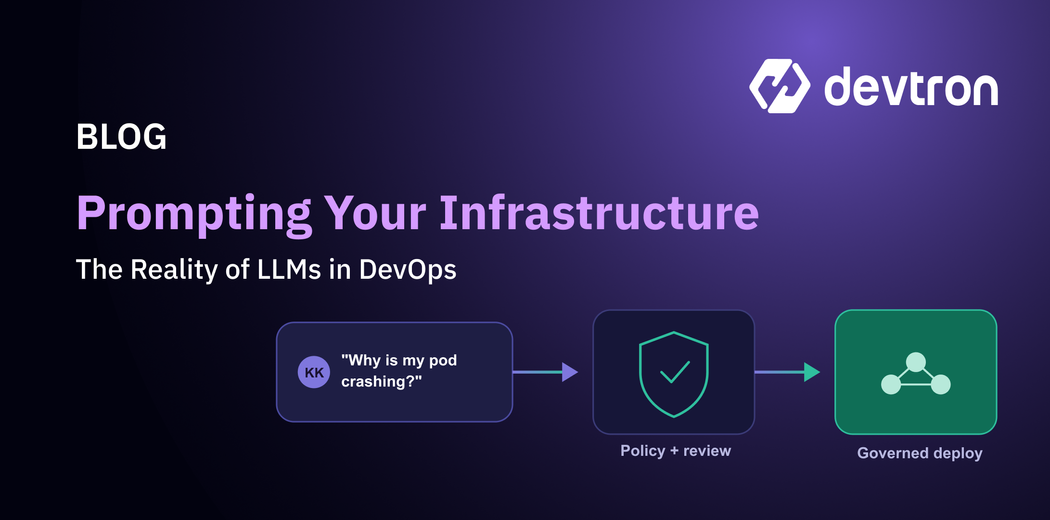
The promise of Generative AI in DevOps is often painted as a "magic wand" scenario: write a prompt, and a fully formed, secure, and optimized Kubernetes manifest appears. However, as organizations move past the initial hype, the reality of integrating Large Language Models (LLMs) into the software delivery lifecycle is far more nuanced.
True "PromptOps" isn't about replacing engineers; it’s about reducing the cognitive load required to manage increasingly complex distributed systems.
Beyond the Chatbot: The Context Gap
In the world of DevOps, an LLM is only as smart as the data it can ingest. If you ask a generic AI agent, "Why is my service latent?" it will give you a checklist of "usual suspects." But the agent doesn't know your CI/CD history, your specific Kubernetes events, or your actual traffic metrics.
To transform an LLM from a "generic advisor" into a "production troubleshooter," it needs access to a Kubernetes-native platform that supports the full application lifecycle.
1. Integrating CI/CD Metadata into the Prompt
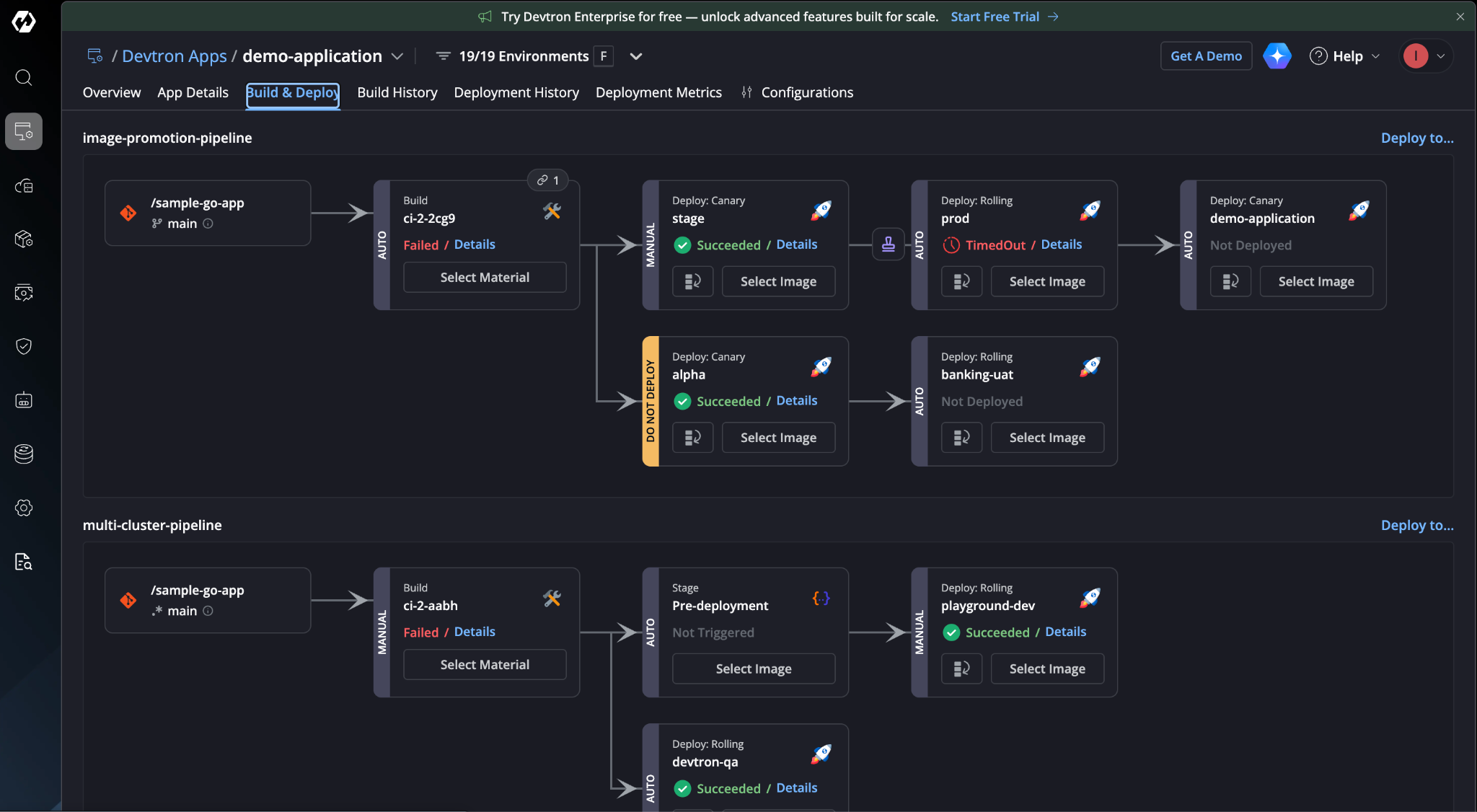
Troubleshooting usually starts with the question: "What changed?" Because Devtron provides native CI/CD pipelines, it knows exactly which commit was deployed, who approved it, and which container image is currently running. When an AI agent has access to this pipeline metadata, it can immediately correlate a spike in 5xx errors with a specific code change, rather than guessing across the entire infrastructure.
This traceability isn't abstract, it's visible directly in the pipeline itself. Every build, its status, and its path across environments is tracked in one place, giving an AI agent a concrete trail to follow instead of a blind guess as you see below in Devtron's Build & Deploy pipeline view :
2. The Power of "State + Metrics."
An AI agent needs more than just YAML manifests; it needs the "heartbeat" of the application. By consolidating application metrics (CPU, Memory, Latency) and Kubernetes events within a single pane of glass, Devtron provides the "Ground Truth."
- The AI Perspective: Without context, an agent sees a crashing pod.
- The Devtron-Enhanced Perspective: With context, the agent sees a crashing pod immediately following a ConfigMap change, paired with a memory limit breach visible in the native metrics dashboard.
3. Closing the Feedback Loop
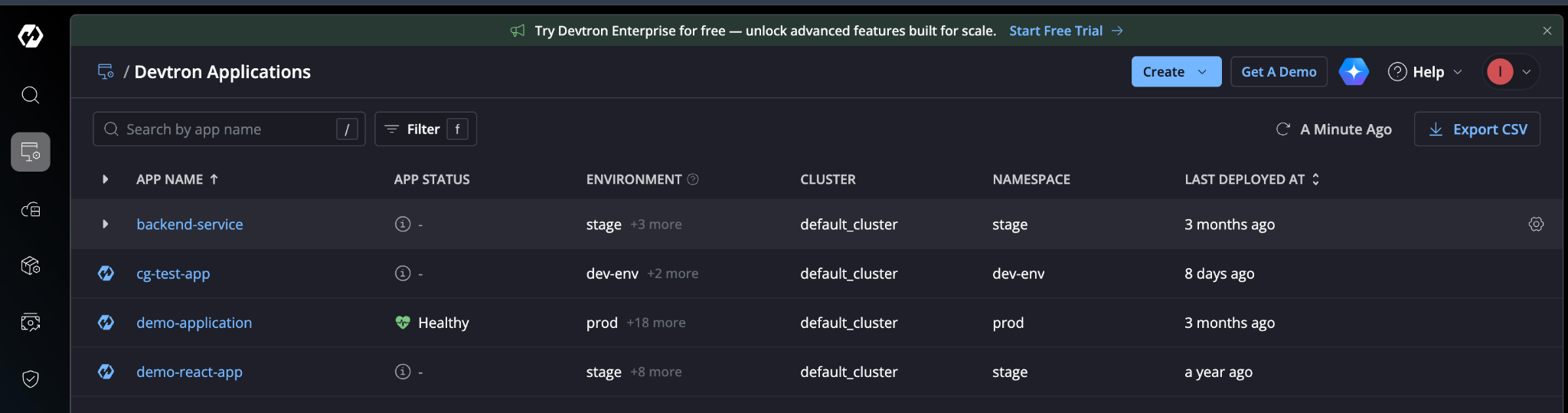
For LLMs to move from "suggesting" to "remediating," they need a secure way to interact with the cluster. Devtron’s structured environment allows AI agents to suggest precise, K8s-native deployments or rollbacks within a governed framework. This prevents the "Wild West" of AI-generated scripts running amok in production.
In Devtron every application, its environment, cluster, and last-deployed status stays visible in one governed place so any AI-proposed change is happening inside a system that's already being tracked, not off in the dark as shown below :
The Risk of "Black Box" Infrastructure
Relying on LLMs introduces a new category of technical debt: hallucinated configurations. A misplaced livenessProbe or a misinterpreted securityContext can lead to silent failures that are difficult to debug.
Thought leadership in this space suggests a "Human-in-the-loop" (HITL) framework:
- AI Generates: Proposes changes based on natural language intent.
- Policy-as-Code Validates: Tools like OPA (Open Policy Agent) or Kyverno check the proposal against hard organizational rules.
- Engineer Audits: A final human review before the "Apply" button is hit.
Operationalizing LLMs with GitOps
For LLMs to be effective in DevOps, they cannot exist in a vacuum. They must be tethered to a structured delivery platform. This is where the synergy between AI and platforms like Devtron becomes evident.
By using an integrated orchestration layer, the "prompts" sent to an LLM are grounded in the cluster's actual state. When you utilize a platform like Devtron to manage your Kubernetes ecosystem, the LLM-generated manifests aren't just floating snippets; they are part of a governed, visible GitOps workflow.
This integration ensures that even if an LLM suggests a change, it is deployed through a structured pipeline with built-in monitoring and easy rollbacks.
The Future: From Prompting to Predicting
We are moving toward a reality where we don't just prompt for creation, but for remediation.
"Why is my pod crashing in the production namespace?" In this scenario, an LLM trained on your logs and metrics, acting as a layer over your internal developer platform, can provide a root-cause analysis in seconds, rather than minutes of manual kubectl debugging.
This shift doesn't happen by accident. It requires infrastructure that was built with this outcome in mind, rather than AI features stapled onto a legacy dashboard after the fact.
Devtron's AI-native platform was designed around exactly this premise: that an AI teammate is only as useful as the operational context it's allowed to see, and the only way to make that context trustworthy is to unify it under one governed system rather than scatter it across a dozen disconnected tools.
From Reactive Fixes to Predictive Operations
The next stage of this evolution isn't just answering "why did this break," but anticipating that "it will break" , in the first place. This is where the "State + Metrics" foundation discussed earlier starts to compound in value. When an AI agent has continuous, historical visibility into deployment patterns, resource consumption, and cluster events, it stops being a reactive troubleshooter and starts becoming a predictive one .
For example flagging a memory leak trend three deployments before it causes an outage, or catching a misconfigured autoscaler before it triggers a cascading failure during a traffic spike.
Devtron's application management layer is built specifically to support this kind of longitudinal visibility of correlating logs, events, and metrics across the application, pod, node, and cluster levels, so that when an AI agent reasons about a problem, it isn't working from a single snapshot in time but from the full operational history of that workload.
Governance as an Enabler, Not a Blocker
It's worth restating why the HITL (Human-in-the-loop) framework matters so much here. Skipping the "Policy-as-Code Validates" step might feel like it speeds things up in the short term, but it usually just moves the risk further downstream from a five-minute review today to a much costlier incident in production later.
To get the most value from LLMs in DevOps are the ones treating governance as the thing that makes AI-assisted remediation possible, not as friction to be engineered around.
A platform that already enforces RBAC, approval workflows, and policy checks as part of its normal GitOps process gives an LLM a safe lane to operate in one where "suggest a rollback" can eventually become "execute a rollback" because the guardrails were never optional in the first place.
Conclusion
LLMs won't replace the discipline that good DevOps practice is built on they'll amplify it, for better or worse, depending on the foundation they're given. A generic chatbot bolted onto your infrastructure will generate plausible-looking YAML and confident-sounding root causes, but plausible isn't the same as correct. Organisations getting real value from AI in their delivery pipelines will be the ones that first invested in a structured, observable, governed platform - one where CI/CD metadata, live metrics, and Kubernetes events already live together, and where every AI-proposed change still passes through the same policy checks and human review as everything else.
That's the real "PromptOps" opportunity: not a shortcut around good platform engineering, but a reason to finally get it right.
If your team is exploring how to bring AI safely into your Kubernetes operations, see how Devtron's platform brings CI/CD, GitOps, observability, and AI-driven remediation together under one governed system.