

Continuous Integration and Delivery are supposed to make software delivery predictable.
But when pipelines are built around manual approvals, scattered configurations, unrestricted access, and fragile deployment processes, the opposite happens. A failed deployment on Friday evening can quickly turn into a weekend spent digging through logs, checking YAML, chasing approvals, and figuring out who changed what.
The problem usually isn't that teams lack automation. It’s that their automation has accumulated the wrong patterns.
Here are seven toxic Kubernetes CI/CD mistakes that turn routine releases into weekend firefighting and how Devtron helps to avoid them.
1. Deploying to production with no guardrails
The Problem
Development, staging, and production have different levels of risk, but many CI/CD pipelines treat them almost identically. The same deployment paths, permissions, and automation rules are often used across environments.
That makes it easy for a change that is perfectly acceptable in development to reach production without the additional controls it requires.
The Mistake
Using the same deployment permissions and workflow rules across every environment.
When production deployments depend on tribal knowledge “someone from the platform team needs to approve this” or “don't deploy directly to prod” the control exists only as long as people remember to follow it.
The Fix
Define environment-specific controls directly in the delivery workflow. Production should have explicit permissions, approval gates, promotion rules, and deployment policies rather than relying on manual coordination.
How Devtron Helps
Devtron lets teams apply environment-aware access controls, approval policies, deployment windows, and image promotion workflows. This allows teams to define stricter controls for production while keeping development workflows faster and less restrictive.
You can set up approval workflows for production deployments and for changes to configs and secrets. Each environment gets its own pipeline settings. Dev can stay fast and open while prod needs a second pair of eyes, so a risky release becomes a deliberate decision..
2. Hardcoding secrets in pipelines and manifests
The Problem
CI/CD pipelines often need access to credentials, tokens, environment variables, and application configuration. When these values are embedded directly into pipeline scripts, YAML files, or repository configuration, they become difficult to control and audit.
A credential added for a quick deployment fix can eventually become a long-lived security risk.
The Mistake
Hardcoding secrets or sensitive configuration directly into CI/CD pipelines or source-controlled files.This can expose credentials to anyone with access to the repository or pipeline configuration and makes secret rotation unnecessarily difficult. It also creates a risk of the same sensitive values being reused across multiple environments.
The Fix
Separate secrets and sensitive configuration from the pipeline definition. Control who can access or modify them, inject them only when required, and apply environment-specific configuration rather than embedding credentials into deployment logic.
How Devtron Helps
Devtron separates application configuration from the deployment workflow and provides controlled management of ConfigMaps and Secrets. Secrets are scoped per environment and injected at deployment time. Sensitive values stay out of your repos, and an approval flow on secret changes adds another check.
3. One god-mode kubeconfig for the whole pipeline
The Problem
CI/CD pipelines need access to Kubernetes clusters to deploy workloads, but that access is often configured for convenience rather than least privilege.
A common setup is to give the CI runner a single highly privileged kubeconfig that can access multiple clusters, namespaces, and environments. It works but it turns the pipeline into a single high-value access point.
The Mistake
Giving the CI runner a cluster-admin kubeconfig or broadly privileged service account that can access every environment. A pipeline that only needs to deploy one application to one environment may effectively have permission to modify production, staging, and other workloads across the cluster.
The Fix
Apply least-privilege access to CI/CD. Permissions should be scoped to the application, environment, namespace, and actions the pipeline actually needs. Production deployment access should be explicitly separated from development access, and teams should avoid sharing a master kubeconfig across pipelines or users.
How Devtron Helps
Devtron centralizes RBAC and SSO-based access control so teams can define who can view, deploy, or edit applications across specific environments. Developers can deploy to development without automatically receiving production access, eliminating the need to distribute a shared, highly privileged kubeconfig across the delivery process.
4. Trusting mutable tags and unpinned dependencies
The Problem
A deployment should be reproducible: the same source and artifact should produce the same result regardless of when or where the pipeline runs.
But pipelines often depend on mutable references such as : latest, floating image tags, or third-party actions and plugins referenced only by a version tag. When those references change, the pipeline can execute different code without any change to the pipeline itself.
The Mistake
Deploying mutable image tags or relying on unpinned external dependencies.
For example, deploying my-app:latest does not tell you which exact image digest was deployed. Similarly, a dependency referenced through a movable version tag can change underneath an otherwise unchanged pipeline.
The Fix
Build and promote immutable, traceable artifacts. Every deployment should be tied back to a specific source revision and artifact, ideally using immutable image references or digests. Dependencies used by the pipeline should also be explicitly versioned and governed.
This makes deployments reproducible and makes rollback and incident investigation significantly easier.
How Devtron Helps
Devtron's CI builds an immutable image for every commit and ties each deployment to a specific image and commit. Pipeline stages use configured, auditable plugins rather than ad-hoc scripts pulled from wherever. You always know exactly which artifact is running, and you can pin and promote that same artifact from environment to environment.
5. Shipping images nobody scanned
The Problem
A container image can pass the build and deployment stages while still containing known vulnerabilities, exposed secrets, license issues, or other security risks.
When scanning happens outside the delivery workflow or the results aren't enforced security becomes a separate activity that can easily be skipped when teams are under release pressure.
The Mistake
Allowing container images to reach deployment without an enforced security check. Running a scanner somewhere in the toolchain isn't enough if a critical vulnerability can still move through the pipeline and reach production without an explicit decision or policy.
The Fix
Move security checks into the delivery workflow and define clear policies for what can and cannot be deployed. Critical findings should be surfaced before deployment, with configurable gates where organizational policy requires them.
Security should be part of the release decision, not something investigated after an incident.
How Devtron Helps
Devtron integrates security scanning into the application delivery workflow and surfaces image security findings alongside the build and deployment context. Teams can define security policies and vulnerability thresholds to prevent images that violate those policies from progressing to deployment.
This makes security a measurable release gate rather than a separate, post-deployment activity.
6. No fast way back when a release breaks
The Problem
Even with testing and deployment controls, releases can fail. The real operational risk comes when recovering from that failure requires engineers to manually identify the last working version, locate the correct manifest or image, and reconstruct the rollback process under pressure.
“ Every additional manual step increases mean time to recovery ”
The Mistake
Treating rollback as a manual recovery procedure instead of a standard part of the deployment workflow.
If engineers have to search through deployment history, identify the previous image, and run manual Kubernetes commands to restore the application, recovery becomes slower and more error-prone, especially during an incident.
The Fix
Make rollback a predictable, repeatable operation. Maintain a clear history of deployed versions and ensure teams can return to a previously verified release without reconstructing the deployment from scratch. Progressive delivery strategies such as rolling, blue-green, and canary deployments can also reduce the blast radius of a problematic release.
How Devtron Helps
Every deployment is recorded with its image, config, and who triggered it. Rolling back is a one-click move to a previous known-good release. Devtron also supports rolling, blue-green, and canary strategies, so you can limit how much of a bad release reaches users before you notice.
7. Config drift and manual hotfixes Becomes the Norm
The Problem
Production incidents often create pressure for quick fixes. An engineer changes a live Kubernetes resource directly with kubectl, intending to correct the issue temporarily.
The immediate problem may disappear, but the cluster can now differ from the configuration defined for that application. Over time, these undocumented changes create configuration drift between environments and can be overwritten by the next deployment.
The Mistake
Making direct changes to live workloads instead of updating the declared configuration through the normal delivery workflow. A production hotfix that exists only in the cluster is difficult to reproduce, review, or track. The next deployment may also replace it because the desired configuration was never updated.
The Fix
Keep the desired application state declarative and make Git or the approved configuration source the source of truth. Changes should go through the normal review and deployment workflow so that the intended state, actual state, and change history remain aligned.
Emergency changes should also be captured in the source of truth rather than remaining as undocumented cluster-level modifications.
How Devtron Helps
Devtron supports GitOps-based deployments with Argo CD, helping reconcile the desired application state with the state running in the cluster. Teams can manage environment-specific configuration through the platform, while deployment history and audit information provide visibility into deployment and configuration changes.
This reduces configuration drift and makes it easier to understand what changed, who initiated the change, and when it happened when investigating an incident
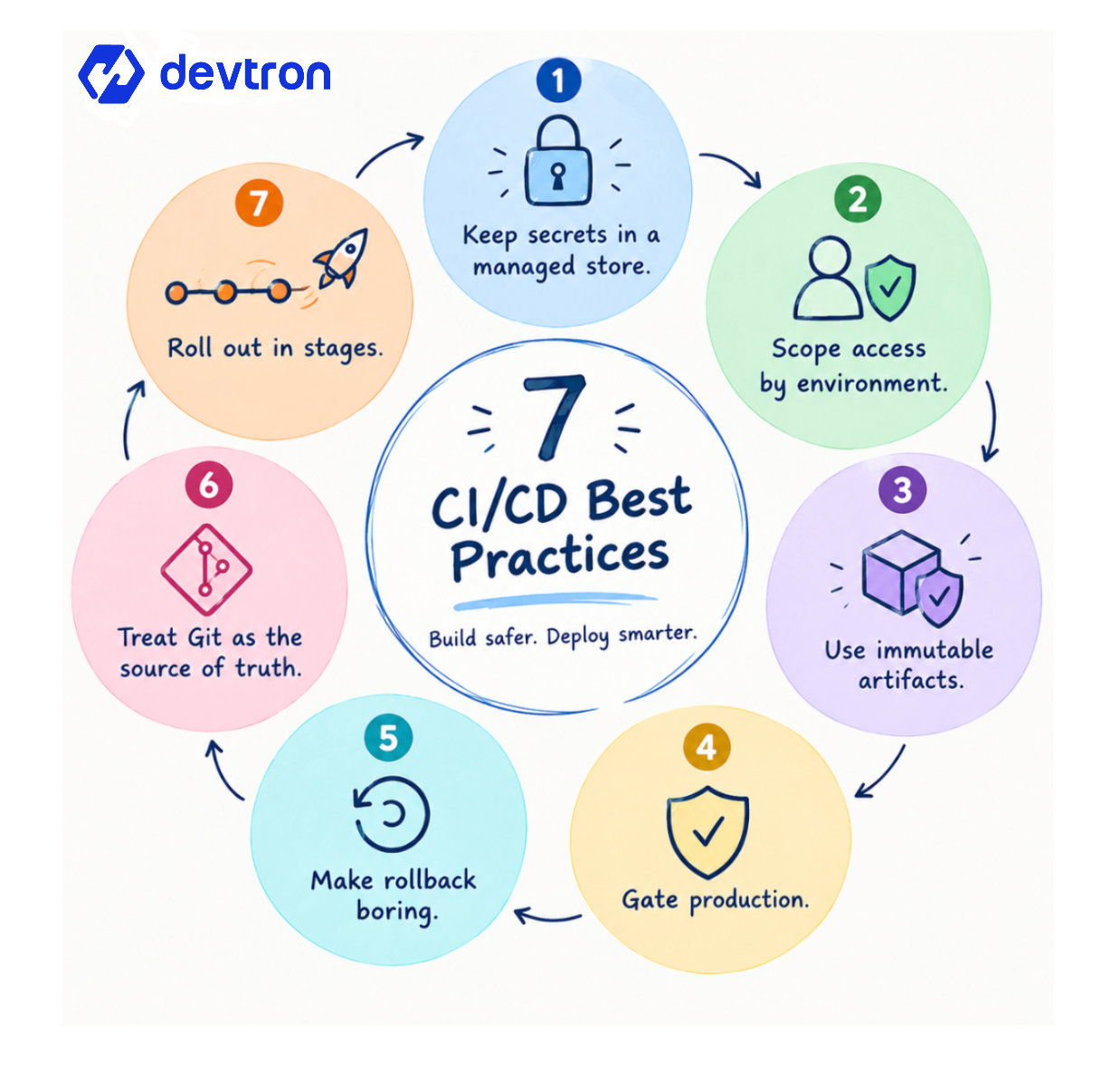
The short best-practices checklist
If you fix nothing else, start here:
- Keep secrets in a managed store - Inject them at runtime and rotate anything that was ever committed.
- Scope access by environment - Use RBAC and SSO, and avoid shared admin credentials.
- Use immutable artifacts - Build once, scan, and promote the same image. No :latest.
- Gate production - Require approvals, scan results, and sensible deployment timing.
- Make rollback boring. - A release you can undo in one click is a release you can ship with confidence.
- Treat Git as the source of truth - No manual edits to live clusters.
- Roll out in stages- Start with visibility, then add policy, then enforce, so teams see what would fail before anything actually blocks them.
Take Your Weekends Back
None of these CI/CD mistakes are exotic. They usually start as small shortcuts, a shared kubeconfig, a latest tag, a manual production fix, or a rollback process that was never properly defined. Over time, those shortcuts become operational debt, making releases harder to control, troubleshoot, and recover.
Reliable CI/CD is about making failures contained, traceable, and recoverable. With the right access controls, immutable artifacts, security gates, deployment strategies, and GitOps practices, teams can make releases more predictable and spend less time firefighting.
Try out Devtron Demo and see how it can help to build secure, controlled, and reliable Kubernetes delivery workflows.